En
To Luigi Pirandello
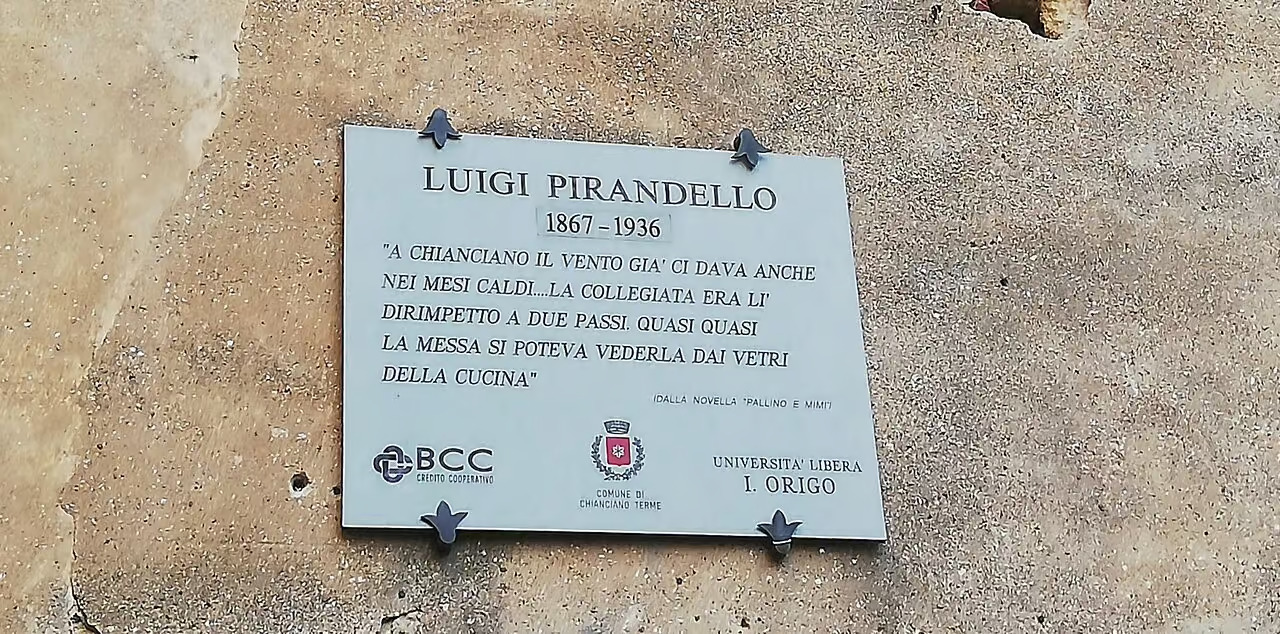
On the upper left, just before the Collegiate Church, a plaque commemorates the stay of Luigi Pirandello at the Brugi–Ronchi pension, where he wrote two of his short stories, "Acqua amara" and "Pallino e Mimì," published in the collection Novelle per un anno (1922).
A walk through the old town of Chianciano Terme follows in the footsteps of Luigi Pirandello who, during a long stay for thermal treatments with his family, wrote the two short stories "Pallino e Mimì" and "Acqua Amara." The path leads from the Clock Tower (Torre dell’Orologio) to the former hospital of Chianciano—linked to the illness and hospitalization of the writer's wife—where the author met characters who, more or less clearly, inspired the traits of his protagonists.
The year 1905 stands out as a key moment in Pirandello's biography, the year in which Pirandello stayed with his family in Chianciano Terme.
It was a long stay—as was customary at the time—primarily intended to improve the fragile health and shaken nerves of his wife, Antonietta Portulano, who would later spend forty years of her life in a psychiatric nursing home.
At the time of his stay in Chianciano, the Master from Agrigento was fresh from the success of his novel "The Late Mattia Pascal" and had not yet written anything for the theatre. Many of his greatest successes were yet to come, but his spirit of observation and ability to capture the most hidden and destabilizing aspects of the human psyche were already a foundational element of his creativity. This is evident in the themes that powerfully emerge from the two short stories he wrote during his stay in Chianciano: Pallino e Mimì and Acqua Amara.
Reading these two stories reveals his full skill as a chronicler of small yet significant daily events, which together contribute to creating the "masks" that early 20th-century society wore so casually. Pirandello's Chianciano stories tell us all this and more: love, madness, masks, and human pettiness. But they also tell us about a town—Chianciano—rich in a vitality that flows into the tourist-characters of the two tales, giving us a vintage postcard of a community that already had a clear vocation as a thermal destination capable of offering all-encompassing tourist experiences.
Address:
Collegiata San Giovanni Battista,
Chianciano Terme, SI